
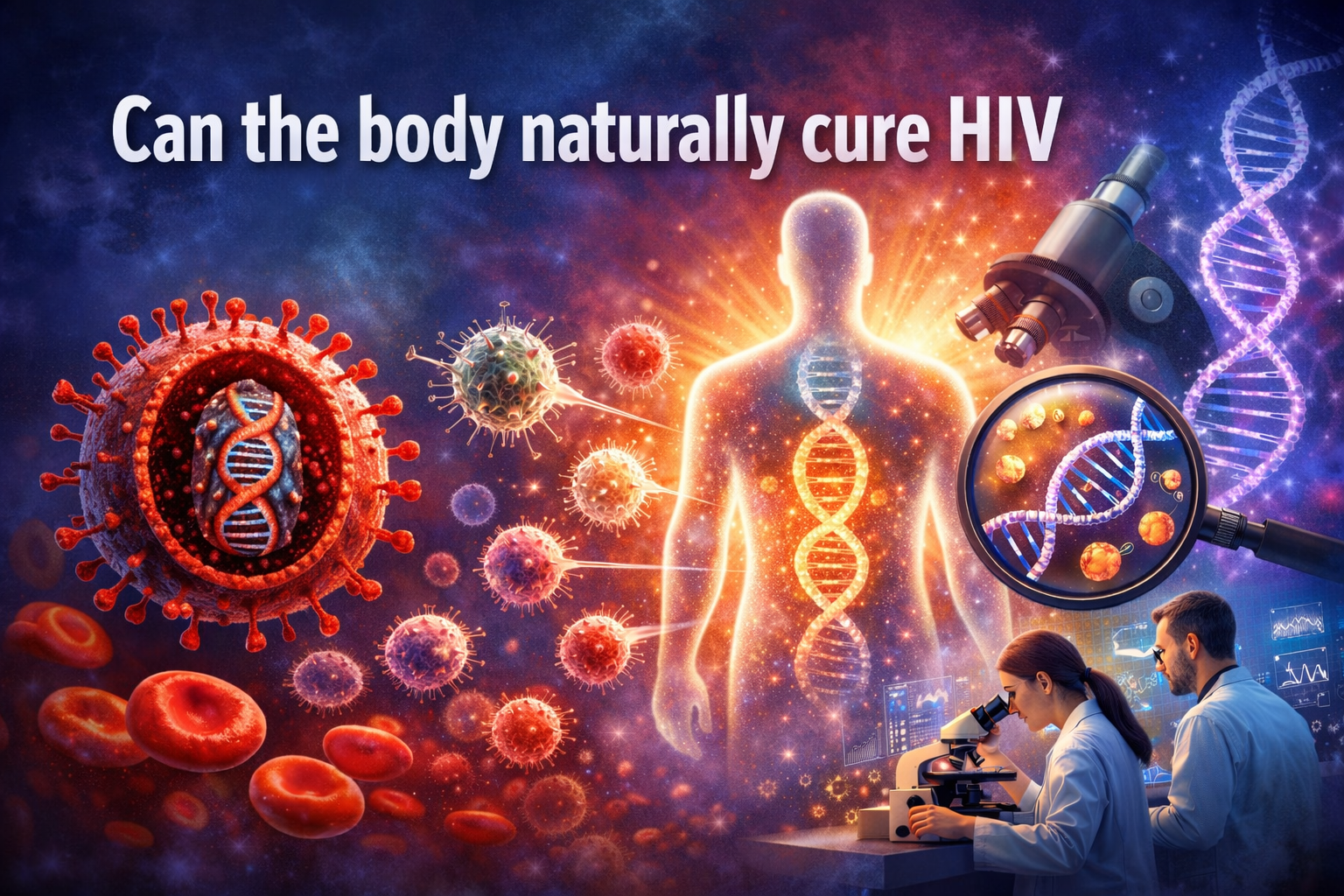
For more than four decades, scientists have pursued a permanent cure for HIV, the virus that causes AIDS. Modern antiretroviral therapy (ART) has turned HIV infection into a manageable condition, but it cannot eliminate the virus hidden inside the body’s long-lived cells. Yet, a few extraordinary individuals have shown that the human immune system itself may hold the key to a natural HIV cure. So, can the body naturally cure HIV—and what biological secrets are hidden within these rare cases?
 The Enigma of Natural Controllers
Among millions living with HIV, fewer than one in two hundred people can suppress the virus without medication. These “elite controllers” maintain undetectable viral loads for decades using their own immune defenses. Another small group, called post-treatment controllers, regain control even after stopping ART. These individuals are not cured in the full sense, but their bodies manage to keep HIV silent—essentially achieving a functional cure.
The biological mysteries behind their success provide critical clues for designing a universal therapy.
 Inside the Body’s Own Defense System
1. Exceptional CD8+ T-cell Power
The most consistent finding among natural controllers is a highly efficient population of cytotoxic CD8+ T-cells—immune warriors that identify and destroy infected cells. These T-cells are unusually focused on conserved regions of HIV, where the virus cannot easily mutate without losing fitness.
2. Broadly Neutralizing Antibodies (bNAbs)
Some people naturally produce powerful antibodies capable of neutralizing diverse HIV strains. These bNAbs, such as VRC01 and 10-1074, arise years after infection in a few individuals. Scientists now clone and engineer these antibodies for therapeutic use, mimicking what the immune system did naturally.
3. Protective Host Genetics
Certain genetic traits protect against HIV progression. For instance, individuals carrying HLA-B57 or HLA-B27 mount stronger immune responses, while those with the CCR5-Δ32 mutation may resist infection entirely by preventing viral entry into cells.
4. Innate Restriction Factors
Proteins like APOBEC3G, TRIM5α, and SAMHD1 act as internal antiviral agents. They degrade viral DNA or block replication steps—an ancient immune defense that still functions in some individuals more efficiently than others.
5. Latent Reservoir Lockdown
Perhaps the most intriguing mechanism is how some controllers integrate HIV DNA into silent or defective parts of the genome. This “deep latency” prevents reactivation, giving rise to a naturally sterilized or inactive infection state.
 Are There “Natural Remedies” That Support These Mechanisms?
There is no herbal or food-based cure for HIV, but many natural compounds can influence immune balance, oxidative stress, and inflammation—factors that affect viral control.
| Category | Natural Source | Biological Effect |
| Polyphenols | Curcumin, Resveratrol, EGCG (green tea) | Modulate viral latency and inflammation |
| Micronutrients | Vitamin D, Zinc, Selenium | Enhance T-cell and NK-cell responses |
| Herbal Adaptogens | Withania somnifera (Ashwagandha), Nigella sativa | Improve immune resilience and stress tolerance |
| Probiotics | Lactobacillus species | Restore gut immunity and reduce microbial leakage |
While these are not substitutes for ART, they contribute to immune restoration and might support the same pathways that natural controllers use.
 Biologicals: Inside vs. Outside
“Natural biologicals” refer to molecules produced inside the patient—antibodies, cytokines, chemokines, and immune cells. These are endogenous.
Modern medicine attempts to replicate them with external biologicals such as:
- Therapeutic monoclonal antibodies
- Engineered T-cells and vaccines
- Nanomedicines that modulate immunity
For instance, novel approaches like Prakasine, a novel non-toxic mercury-based nanomedicine, aim to reprogram immune pathways safely, mimicking natural viral control mechanisms. Such innovations bridge traditional knowledge and modern immunotherapy, bringing us closer to a biological or functional cure.
 What Do These Discoveries Teach Us?
 What Do These Discoveries Teach Us?
- The body already knows how to control HIV—we see it in elite controllers.
- Cure strategies should imitate nature, not oppose it. Boosting innate and adaptive immunity while minimizing inflammation is key.
- Integration of natural and synthetic biologicals—nutraceuticals, immunomodulators, and nanomedicine—offers a balanced, safe, and sustainable route to functional remission.
A Future Guided by Nature and Science
 A Future Guided by Nature and Science
The human body, when properly supported, can achieve extraordinary things. The path to a permanent HIV cure may not lie in one magic drug but in awakening the body’s dormant biological wisdom. Studying natural controllers teaches us that immune harmony, not viral destruction alone, defines long-term remission.
So, when we ask, “Can the human body naturally cure HIV?”, the answer is cautiously hopeful:
Yes, nature has already shown us glimpses of how it can be done — now science must learn to reproduce it for all.
 Author’s Note
By Dr. S.K. Prakash, Founder, Naval AIDS Research Center
Exploring nanomedicine-based immunotherapies such as Prakasine, a novel non-toxic mercury-based nanomedicine aimed at functional HIV cure and immune rejuvenation.