
Introduction
Despite remarkable progress in antiretroviral therapy (ART), a definitive cure for HIV remains one of the most important unmet goals in modern medicine. India, with its strong pharmaceutical and biotechnology ecosystem, has been actively contributing to HIV treatment, vaccine research, and increasingly, curative strategies.
This article explores Indian pharmaceutical companies, biotech startups, and research organizations working toward HIV cure therapies—ranging from functional cure approaches to immune-based eradication strategies—including emerging innovations such as Prakasine, a novel nanomedicine.
Understanding the HIV Cure Landscape
Before identifying the players, it is important to distinguish the two major cure strategies:
- Sterilizing Cure: Complete elimination of HIV from the body
- Functional Cure: Long-term viral suppression without ART
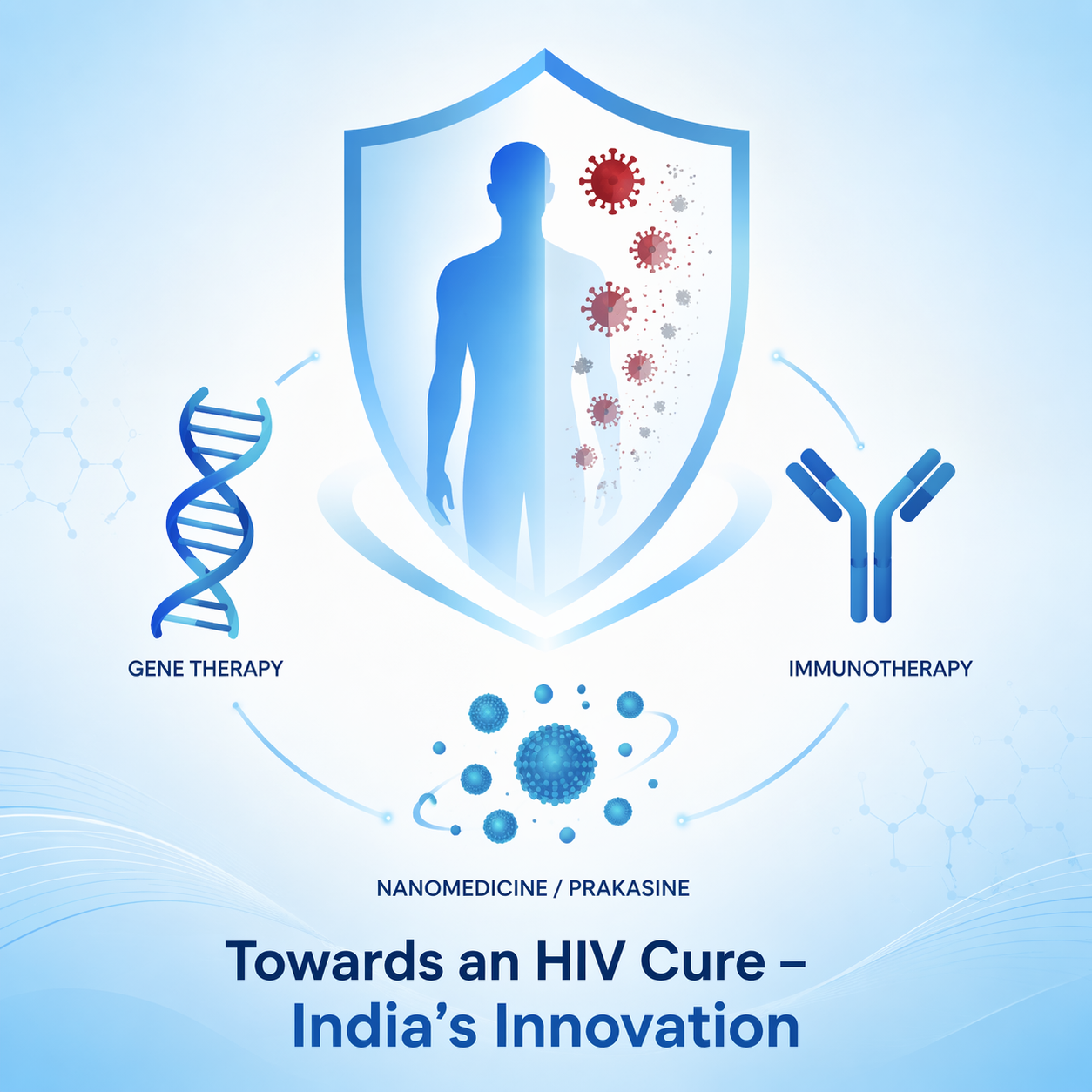
Current global approaches include:
- Latency reversal (“shock and kill”)
- Immune enhancement (CTL/NK activation)
- Gene editing (CCR5 modification)
- Therapeutic vaccines
- Broadly neutralizing antibodies (bNAbs)
- Nanomedicine-based immunotherapy
India’s contribution spans multiple of these domains.
Major Indian Pharmaceutical Companies in HIV Research
1. Cipla Ltd.
- A pioneer in affordable ART globally
- Supplies antiretrovirals to over 100 countries
- Focus area: treatment access rather than cure research
Scientific Position: While Cipla has not directly entered HIV cure research, its manufacturing backbone supports global clinical trials and combination therapies.
2. Sun Pharmaceutical Industries
- India’s largest pharmaceutical company
- Engaged in oncology and immunology research
Relevance to HIV Cure:
- Indirect involvement through immune modulation platforms
- Potential capability to enter HIV cure space via immunotherapy pipelines
3. Dr. Reddy’s Laboratories
- Strong presence in biologics and complex generics
- Collaborations with global biotech firms
HIV Work:
- Focused primarily on ART
- Has infrastructure to support advanced biologics for cure strategies
4. Lupin Limited
- Active in anti-infective and respiratory research
- Manufactures HIV drugs for global markets
Future Potential:
- Could contribute to combination cure regimens or delivery systems
Indian Biotech and Research-Driven Initiatives
5. ImmunoACT (IIT Bombay Startup)
- Focus: CAR-T cell therapy
- Currently working in oncology
Relevance to HIV Cure:
- CAR-T platforms can be adapted for HIV-infected cell targeting
- Represents a next-generation immunological cure pathway
6. ICMR & National Institutes (e.g., NIRT Chennai)
- Conduct HIV reservoir and cure-related studies
- Work on:
- Viral latency
- Immune responses
- Clinical cohort studies
Scientific Contribution:
- Foundational research for cure strategies in Indian populations
Emerging Innovation: Prakasine Nanomedicine Immunotherapy
7. Naval AIDS Research Center (NARC) / Navals Biotech
One of the most distinctive and innovative contributions from India is:
Prakasine – a novel non-toxic mercury-based nanomedicine
Developed over nearly three decades, Prakasine represents a multi-modal immunotherapeutic strategy targeting HIV persistence.
Key Scientific Features:
- Nanoparticle Size: ~90–100 nm (well-characterized by SEM, TEM, DLS)
- Non-toxic Profile: Demonstrated across multiple animal models
- Immunomodulation:
- Induces IL-2, IL-12, IFN-γ, TNF-α
- Activates NK cells and Cytotoxic T Lymphocytes (CTLs)
Anti-HIV Evidence:
- In vitro PBMC studies show 1–2 log viral load reduction
- Collaborative validation at ICMR-NIRT
- Suggests mechanism involving:
- Enhanced immune clearance
- Possible targeting of infected cell reservoirs
Mechanistic Hypothesis:
Unlike conventional ART, Prakasine may:
- Stimulate host immune-mediated killing of infected cells
- Promote functional cure dynamics
- Potentially reduce HIV reservoir burden
Research Status:
- Preclinical validation completed
- Multi-institutional collaborations established
- Positioned for advanced translational and regulatory studies
Challenges in HIV Cure Development in India
Despite promising initiatives, several challenges remain:
- Limited funding for high-risk cure research
- Lack of dedicated HIV cure consortia
- Regulatory complexity for novel therapies
- Need for advanced assays (e.g., IPDA, QVOA, single-cell sequencing)
The Way Forward
India is uniquely positioned to contribute to HIV cure research due to:
- Strong generic pharmaceutical base
- Growing biotech innovation ecosystem
- Large and diverse patient cohorts
- Cost-effective clinical trial infrastructure
To accelerate progress, India needs:
- Public-private partnerships
- Dedicated HIV cure missions
- Translational funding (BIRAC, DBT, ICMR)
- Integration of nanomedicine, immunotherapy, and genomics
Conclusion
While most Indian pharmaceutical companies currently focus on HIV treatment, the shift toward curative research is emerging. Established players provide the infrastructure, while biotech startups and research organizations are driving innovation.
Among these, Prakasine nanomedicine immunotherapy stands out as a uniquely Indian, scientifically grounded approach that integrates nanotechnology with immunology—offering a promising pathway toward a functional HIV cure.
The coming decade may witness India transitioning from a global supplier of HIV drugs to a leader in HIV cure innovation.