
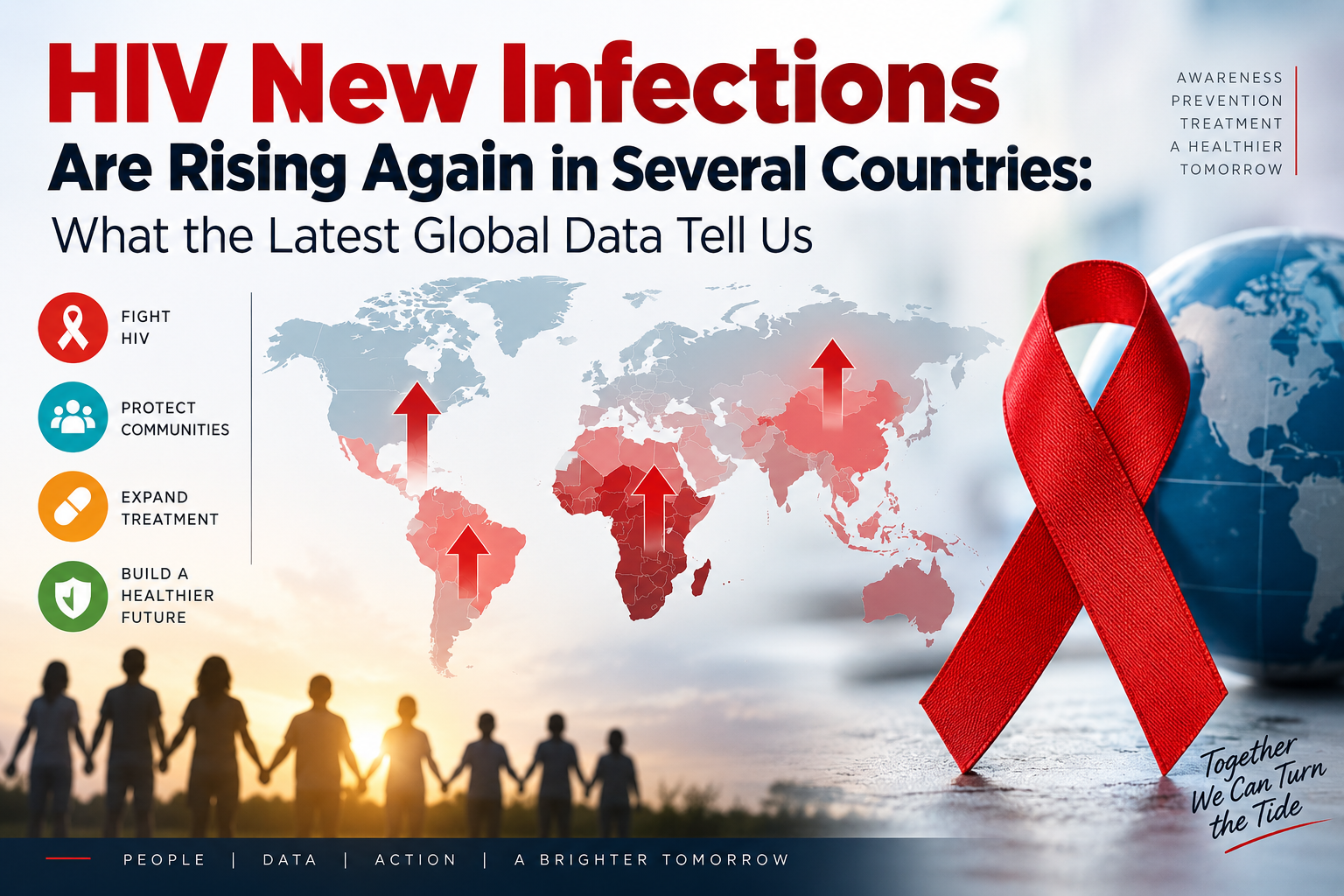
For more than three decades, the global HIV response has achieved major progress. However, the latest international data show an important warning: although the overall number of new HIV infections has fallen dramatically since the peak of the epidemic, HIV transmission is increasing in a number of countries and regions.
According to the latest UNAIDS estimates, approximately 1.2 million people acquired HIV in 2025, compared with about 2.1 million in 2010—a global reduction of approximately 42%. Yet this progress is uneven, and 21 countries recorded increases of more than 20% in new HIV infections between 2010 and 2025. [1]
Global HIV: progress is real, but the decline is slowing
The global HIV epidemic has changed considerably since the 1990s. New HIV infections peaked at approximately 3.5 million in 1994. By 2025, the estimated number had fallen to 1.2 million.
However, the world is still far from the target of ending AIDS as a public-health threat by 2030. UNAIDS reported that new infections increased in three regions in 2025, while approximately 9 million people living with HIV were not receiving antiretroviral therapy. [1]
The regional picture is particularly important.
Compared with 2010, the number of new HIV infections in 2025:
- Eastern and southern Africa: decreased by about 62%
- Western and central Africa: decreased by about 46%
- Asia and the Pacific: decreased by about 21%
- Eastern Europe and Central Asia: increased by about 17%
- Latin America: increased by about 25%
- Middle East and North Africa: increased by about 78%
- Caribbean: decreased by about 30%
- Western and central Europe and North America: decreased by about 10%
Thus, the global decline hides important regional epidemics that are moving in the opposite direction. [2]
21 countries are experiencing increases
UNAIDS’ 2026 analysis identified 21 countries with more than a 20% increase in new HIV infections between 2010 and 2025, among countries with sufficiently comparable estimates.
The countries are:
| Region/area | Countries with increasing new HIV infections |
| Asia & Pacific | Afghanistan, Bangladesh, Pakistan, Philippines, Sri Lanka |
| Middle East & North Africa | Algeria, Egypt, Sudan, Tunisia, Yemen |
| Eastern Europe & Central Asia | Armenia, Kyrgyzstan |
| Latin America | Brazil, Costa Rica, Paraguay, Peru, Venezuela |
| Africa | Congo, Madagascar, Niger, Senegal |
This does not mean that every one of these countries experienced the same magnitude of increase, nor that their epidemics have the same causes. The UNAIDS classification identifies countries where estimated new infections in 2025 were more than 20% higher than in 2010. [2]
Philippines: one of the clearest examples of a rapidly changing epidemic
The Philippines provides one of the most striking examples in Asia.
WHO and UNAIDS reported in 2025 that the number of newly diagnosed HIV cases had increased from approximately 4,400 in 2010 to 29,600 in 2024, a rise of about 550%. UNAIDS also reported that three to four people were newly infected every hour in the Philippines in 2024, with young people aged 15–24 accounting for almost half of those infections. [3][4]
The Philippines demonstrates why HIV prevention cannot depend only on treatment. A large proportion of people living with HIV who remain untreated can contribute to continuing transmission, while prevention services must reach younger and other populations at higher risk.
Fiji: a current warning for the Asia-Pacific region
Fiji has become an especially urgent example in 2026.
UNAIDS estimates that new HIV infections in Fiji increased twelve-fold between 2010 and 2025. The country declared HIV a national crisis in September 2026.
Fiji’s health authorities recorded 2,016 newly diagnosed cases in 2025, 27% higher than the 1,583 cases recorded in 2024. Only about 39% of people estimated to be living with HIV knew their status and approximately 22% were receiving antiretroviral treatment. [5][6]
Reported transmission has involved both sexual transmission and injecting drug use. Health authorities have specifically highlighted the increasing use of methamphetamine and unsafe injection practices as important factors. [5]
The Fiji experience shows how rapidly an HIV epidemic can change when prevention, testing, harm-reduction services and treatment coverage do not keep pace with emerging risks.
What is happening in India?
India presents a different picture.
According to India’s HIV Estimation 2025 Technical Report, approximately 64,470 people newly acquired HIV in 2024. The estimated HIV incidence rate was 0.05 per 1,000 uninfected population, compared with 0.11 in 2010—a reduction of approximately 56%.
The estimated number of annual new HIV infections had also declined by approximately 49% between 2010 and 2024. [7]
Therefore, India should not be described as a country experiencing a generalized increase in new HIV infections. Nevertheless, continued surveillance remains essential because HIV transmission is concentrated in particular populations and geographic areas, and local increases can occur even when the national trend is declining.
Why are new HIV infections increasing in some countries?
There is no single explanation. Several factors are interacting.
1. Insufficient HIV prevention
UNAIDS reports that prevention has historically received a relatively small proportion of total HIV spending. Recent reductions in international funding have created additional pressure on prevention programmes, including HIV testing, condoms, community outreach and PrEP. [1][8]
2. Gaps in HIV testing
People who do not know their HIV status may not receive treatment or prevention counselling. Late diagnosis also makes it more difficult to interrupt transmission chains.
3. Unequal access to treatment
Antiretroviral therapy dramatically reduces HIV-related illness and, when viral suppression is achieved and maintained, prevents sexual transmission of HIV. However, millions of people living with HIV remain outside effective treatment.
4. Transmission among key populations
Globally, people from key populations and their sexual partners account for a substantial proportion of new HIV infections. These populations can face stigma, discrimination, criminalization and barriers to healthcare. [9]
5. Unsafe injecting practices
In several countries, particularly parts of Eastern Europe, Central Asia and some Pacific settings, injecting drug use remains an important transmission route. Lack of access to sterile injecting equipment and harm-reduction services can accelerate transmission. [5][10]
6. Young people and changing sexual networks
In some countries, particularly where epidemics are growing rapidly, a large proportion of new infections occurs among younger adults. Prevention programmes therefore need to reach young people with accurate information, testing, condoms, PrEP and accessible healthcare.
7. Stigma and discrimination
Fear of being identified as HIV-positive can discourage people from testing and treatment. UNAIDS has also reported continuing concerns about laws and policies that criminalize or marginalize populations disproportionately affected by HIV. [1]
The most important lesson: global averages can hide local HIV epidemics
The latest evidence does not show that HIV is universally increasing. Instead, it shows a diverging epidemic.
Some countries have achieved very large reductions in new infections, while others are experiencing substantial increases. Eastern and southern Africa has demonstrated that sustained prevention, testing, treatment and community-based programmes can dramatically reduce transmission. At the same time, the increases in countries such as the Philippines and Fiji demonstrate that HIV epidemics can change rapidly.
This makes country-level and population-level surveillance extremely important.
Conventional HIV diagnosis remains essential, but advanced monitoring can provide additional information about the status of infection and treatment response. Measurements such as HIV antibody titre, HIV proviral DNA PCR, integrated HIV DNA quantitative PCR and quantitative HIV RNA PCR can help characterize different aspects of HIV infection when used appropriately within clinical or research protocols.
The future HIV response therefore needs two complementary approaches: stronger prevention to stop new infections and better scientific approaches to understand, monitor and ultimately eliminate persistent HIV infection.
The global decline in HIV infections is an important achievement—but the latest country-level data remind us that the epidemic is not over.
References
- UNAIDS. Global HIV & AIDS Statistics / 2026 Special Report.
- UNAIDS. Progress in reducing numbers of new HIV infections has been greatest in sub-Saharan Africa; 21 countries are still seeing rising new HIV infections, 2026.
- WHO Philippines. UNAIDS, WHO support DOH’s call for urgent action as the Philippines faces the fastest-growing HIV surge in the Asia-Pacific region, 11 June 2025.
- UNAIDS. Funding cuts undermine community-led innovations in the Philippines, July 2025.
- UNAIDS. UNAIDS to support Fiji as it declares HIV a national crisis and puts in new measures to strengthen the response, September 2026.
- Fiji Ministry of Health and Medical Services. 2025 National HIV Statistics: Summary Report, 2026.
- National AIDS Control Organisation (NACO), Government of India. HIV Estimation 2025 Technical Report.
- UNAIDS. Global AIDS Update 2025: AIDS, Crisis and the Power to Transform.
- UNAIDS. With new HIV infections rising in a growing number of countries and regions, urgent action is needed to turn the prevention crisis around, 2024.
- UNAIDS. Eastern Europe and Central Asia Regional Profile, Global AIDS Update.